Making Light Work of Temporary Structure Installation
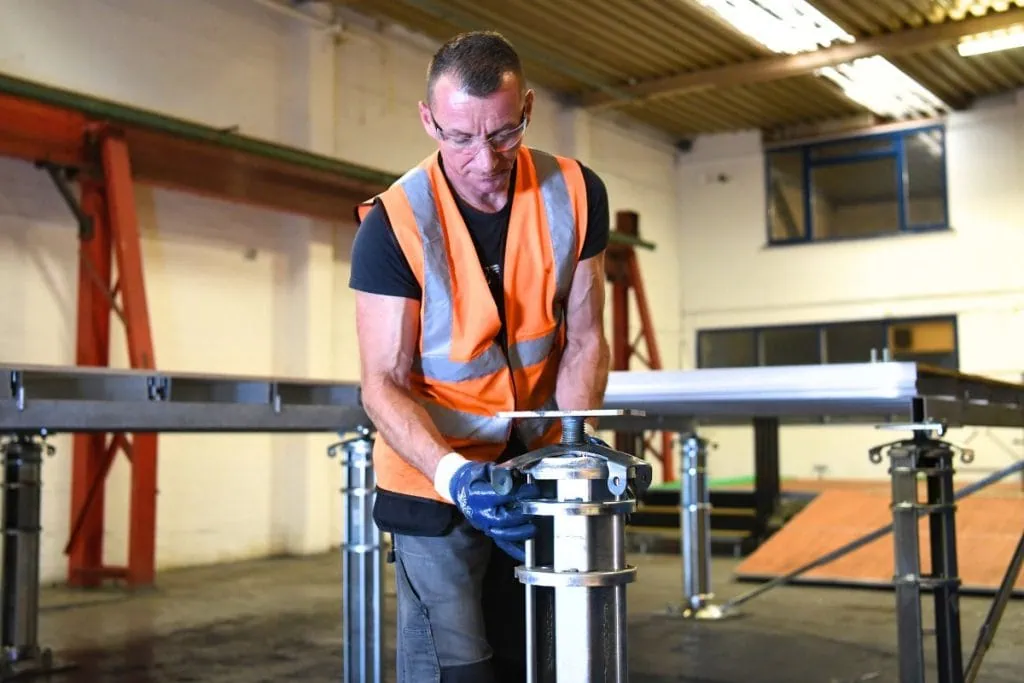
The ability to establish a stable, level base quickly is becoming an increasingly important consideration for organisations deploying temporary buildings, modular accommodation and site infrastructure. Regent Engineering’s FloorStak® system has been developed with simplicity of installation at its heart.
Manufactured in the Black Country by Regent Engineering, FloorStak provides an engineered support and levelling system that allows temporary structures to be installed on uneven or sloping ground, helping contractors reduce preparation work, installation time and associated costs. Its appeal lies in a straightforward principle: a modular arrangement of adjustable steel supports that can be configured to suit the ground conditions and the structure being installed.
For Stuart Whitehouse, Managing Director of Regent Engineering, the simplicity of the system is one of its greatest strengths.
“Anyone involved in installing temporary structures understands how much time can be spent preparing a site before the building itself can be positioned,” explained Whitehouse. “With FloorStak, we have concentrated on making that process as straightforward as possible. The components are designed for practical installation, with the flexibility to accommodate different ground levels and building configurations. It means contractors can establish a suitable supporting structure efficiently and get on with the wider project.”
FloorStak uses modular, formed and welded steel components to create a stable supporting substructure beneath temporary buildings and flooring systems. The adjustable arrangement accommodates installation heights from 0.17 metres to 2 metres and terrain slopes of up to 12 degrees, providing considerable flexibility across construction sites, industrial premises and temporary accommodation projects.
The system can be installed and subsequently dismantled for redeployment, making it particularly attractive to organisations managing multiple sites or regularly relocating temporary facilities.
“Ease of assembly was an important consideration throughout the development of FloorStak,” continued Whitehouse. “We wanted a system that contractors could work with efficiently, using a consistent approach across different installations. When you have multiple units to position, the time spent on each installation quickly adds up. A straightforward assembly process can make a considerable difference to the overall programme.”
Behind FloorStak’s practical installation process is the manufacturing expertise developed by Regent Engineering over more than 85 years. The Darlaston business manufactures the system using formed and welded steel construction in compliance with EN 1090, within an ISO 9001-certified manufacturing environment.
Each supporting leg has a maximum specified vertical load of seven tonnes, incorporating a safety factor of 1.5, with independent testing undertaken by Lloyds British Testing Ltd. The system also carries TÜV technical approval under report number 3300-12539-2025 BT.
This combination of structural performance and straightforward installation has applications across construction site accommodation, welfare cabins, temporary offices, exhibition facilities, modular compounds and temporary retail buildings. For organisations procuring temporary infrastructure across multiple locations, standardised components also offer advantages in transport, storage and repeated deployment.
“Engineering a product for simplicity requires considerable thought about how it will actually be used,” added Whitehouse. “Our experience in steel fabrication, presswork and welded assemblies has allowed us to develop a system that combines structural capability with a practical approach to installation. We see considerable opportunities for FloorStak wherever organisations need to establish temporary infrastructure quickly and reliably.”
The ability to recover and reuse FloorStak components adds another dimension to the system’s appeal. For contractors, hire companies and operators of temporary accommodation, components can be transported between projects and configured for different site requirements, helping reduce whole-life costs.
With demand for flexible accommodation and rapidly deployable facilities across construction, defence, aerospace and major events, Regent Engineering believes the practical advantages of a standardised support system will continue to attract interest.
“Temporary buildings are often required at short notice, and the installation programme can be demanding,” concluded Whitehouse.
“FloorStak gives contractors a practical way to approach those requirements. The system is straightforward to assemble, adjustable to suit the site and designed to be used repeatedly. That simplicity is a major part of its value.”