
FloorStak Helps Deliver World-Class Infrastructure for International Sporting Stage
Temporary venues are becoming a defining feature of major international sporting events, allowing organisers to transform existing facilities into world-class competition arenas while delivering the flexibility, efficiency and performance demanded by elite athletes.
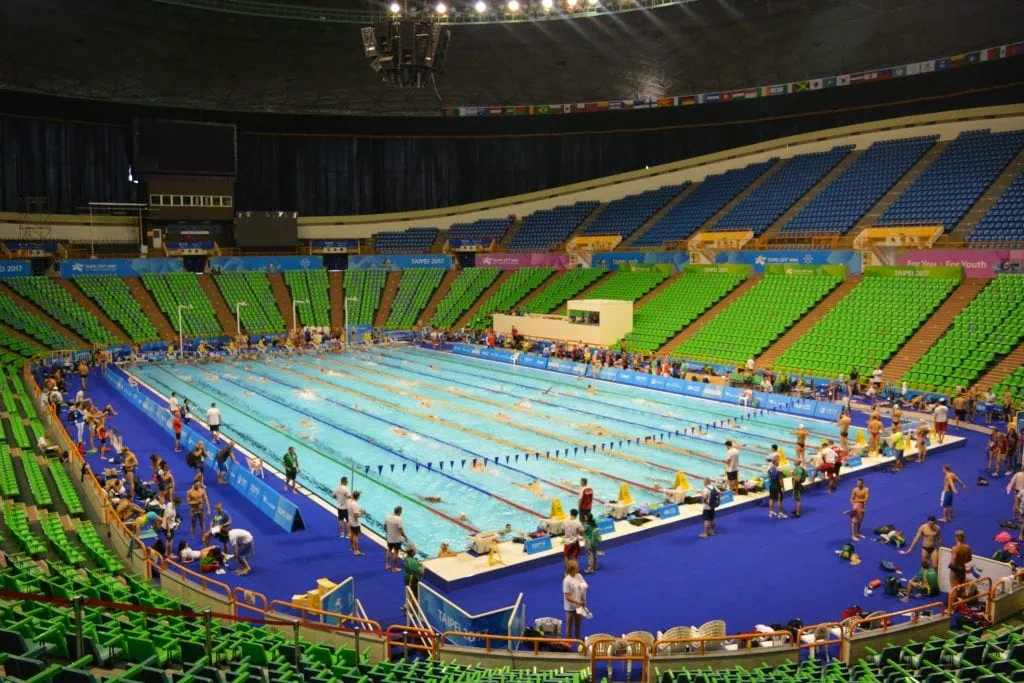
One example of this engineering capability came when Regent Engineering’s FloorStak modular support system played a central role in creating the access infrastructure surrounding the temporary Olympic-size swimming pool used during the Universiade Games in Taipei, Taiwan.
Often described as the world’s second-largest multi-sport event after the Olympic Games, the Universiade attracts thousands of university athletes from across the globe. The 2017 event welcomed more than 12,500 competitors, with Taipei University Multi-Purpose Stadium converted into the principal venue for the swimming programme through the installation of a temporary Olympic-standard pool.
Creating safe, unrestricted access around the pool presented a significant engineering challenge. The platform surrounding the pool needed to accommodate filtration systems, run-off tanks and other critical infrastructure while providing uninterrupted routes for athletes, officials and event staff throughout the competition.
Working alongside local engineering teams, Regent Engineering developed a bespoke configuration using its FloorStak and iStak modular support systems to create a robust support structure in areas where space was exceptionally limited.
The solution supported a purpose-built cassette flooring system installed around the entire perimeter of the pool, while Regent’s modular staircase system provided safe access between the stadium floor and pool level.
The project demonstrated how modular engineering can solve complex infrastructure challenges without compromising on safety, accessibility or installation efficiency.
Stuart Whitehouse, Managing Director of Regent Engineering, said the project reflected the versatility that organisers increasingly require when delivering temporary venues for global events.
“Major sporting events demand infrastructure that performs to the highest standards while adapting to environments that were never originally designed for competition,” he said.
“Every venue presents its own engineering challenges. In Taipei, the support structure had to work around filtration equipment and confined spaces while providing reliable access for thousands of athletes, officials and support teams. FloorStak’s modular design allowed us to configure a solution that fitted precisely to the available space.”
As international sporting, entertainment and exhibition events continue to seek adaptable infrastructure, modular engineered systems are playing an increasingly important role in helping organisers maximise existing venues while reducing installation complexity.
Unlike conventional temporary structures, modular systems can be rapidly configured to suit individual sites before being dismantled, reused and redeployed on future projects, providing long-term value across multiple events.
Whitehouse believes this flexibility is becoming one of the defining characteristics of modern event infrastructure.
“Whether it’s an international sporting venue, an airshow, outdoor exhibition or major public event, organisers are looking for engineered systems that can be installed efficiently, perform reliably and be used again and again,” he said.
“That’s exactly what FloorStak has been designed to deliver. It’s an engineered solution that combines strength, adaptability and reusability, allowing clients to overcome complex site constraints while protecting the investment they’ve made in their infrastructure.”
The Universiade project remains a strong example of how British engineering expertise continues to support prestigious international events, demonstrating that innovative modular systems can help transform existing venues into competition-ready environments capable of performing on the world stage.