

Engineering Better Matchday Access at Anfield and Stamford Bridge
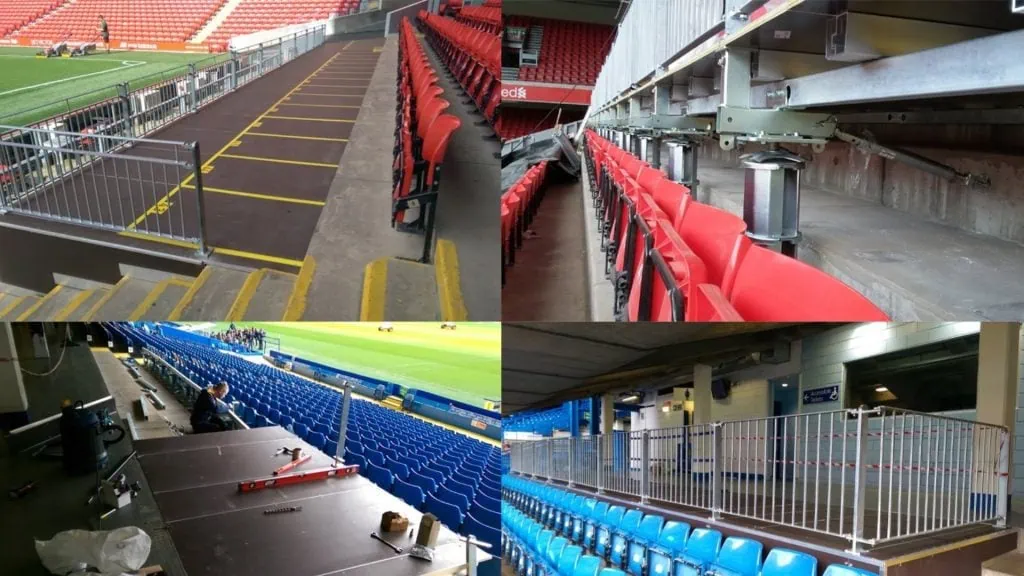
Regent Engineering’s FloorStak system has helped create adaptable spectator platforms for wheelchair users at two of English football’s most recognisable stadiums, combining accessibility, modular engineering and rapid installation within demanding close-season programmes.
Football stadiums are places designed around atmosphere, visibility and the shared experience of matchday. Creating that experience for every supporter also requires careful engineering behind the scenes.
At Anfield and Stamford Bridge, Regent Engineering was tasked with providing demountable spectator platforms designed to improve facilities and viewing positions for wheelchair users while giving stadium operators the flexibility to configure spectator capacity around demand.
The projects demonstrated how the West Midlands manufacturer’s FloorStak modular flooring and levelling system can be adapted beyond conventional temporary flooring applications to solve complex access and infrastructure requirements.
For Regent Engineering Managing Director Stuart Whitehouse, the installations highlight the value of combining a proven modular system with bespoke engineering.
“Projects like these demonstrate what can be achieved when you start with a flexible engineered system and then design around the individual environment,” said Whitehouse.
“A football stadium presents a very particular set of requirements. You are working within an existing structure, sightlines are important, accessibility is fundamental and the installation programme has to fit around the operational demands of the club. FloorStak gives us a strong engineering platform from which to develop the right solution.”
Football grounds have responsibilities under UK equality legislation to provide appropriate facilities for disabled supporters, making accessibility an important consideration in the continued development of stadium infrastructure.
The programmes at Anfield and Stamford Bridge formed part of wider improvements to facilities for disabled spectators.
These included increasing wheelchair provision from 195 to more than 250 positions, creating over 150 additional amenity and easy-access seats, improving viewing positions for visiting disabled supporters and introducing new raised wheelchair bays within the stands.
A central part of the design brief was flexibility.
Rather than creating permanently fixed structures, the spectator platforms needed to be demountable in sections. This allows the space allocated to wheelchair users to be configured in response to requirements while retaining the integrity and performance expected of stadium infrastructure.
Whitehouse said this adaptability is one of the characteristics that makes modular engineering particularly valuable.
“Modularity gives operators options,” he explained. “A structure can be engineered for its immediate purpose while retaining the ability to be reconfigured as requirements develop.
“That is increasingly important across many of the sectors we work in. Customers want engineered infrastructure that performs precisely as required while giving them flexibility over how that asset is used throughout its life.”
Standard components meet bespoke engineering
Regent developed the stadium platforms using a combination of standard FloorStak components and specially designed parts.
FloorStak uses adjustable steel components to create level supporting structures across different heights and underlying surfaces. Its modular architecture means configurations can be developed around individual site requirements, with bespoke components incorporated where the application demands them.
For the stadium projects, much of the manufacturing work was completed away from the venue.
The platforms were manufactured off-site before being taken to the stadiums for installation, helping Regent make maximum use of the tightly controlled close-season programme.
Both installations were completed within the three-week out-of-season windows allocated by the clubs.
“Off-site manufacture gives us the opportunity to do a significant proportion of the engineering before arriving at the final location,” said Whitehouse.
“When access to a site is governed by a specific programme, preparation becomes incredibly valuable. Components can be manufactured and organised around the installation sequence so that the team arriving on site is focused on delivering the structure efficiently.”
Major sporting venues, exhibition sites, temporary structures and live event environments frequently have tightly defined installation periods. Infrastructure may need to be created between fixtures, performances or other scheduled activities, placing an emphasis on systems that combine engineering performance with efficient assembly.
FloorStak has been developed around that principle.
Its applications range from raised floors, platforms and walkways to temporary structures and access solutions, allowing Regent to apply the same core modular engineering philosophy across very different environments.
The Anfield and Stamford Bridge projects also demonstrate how British manufacturing capability can contribute directly to the experience people have inside some of the country’s highest-profile venues.
“Most supporters attending a match will naturally be focused on the football,” Whitehouse added. “Behind that experience is an enormous amount of engineering and infrastructure that helps the stadium operate effectively.
“We are proud that Regent Engineering and FloorStak have played a part in creating accessible, adaptable spectator facilities at two iconic football grounds. It is a great example of engineering delivering a practical outcome that makes a genuine difference to the matchday experience.”