

Agile Capacity, British Capability: Why Tier 2/3 Manufacturers Hold the Key to Unlocking the UK’s Defence Dividend
As the UK sets its sights on a significant uplift in defence spending, the conversation is increasingly turning from how much will be spent to where that investment will land — and how quickly industry can respond.
A recent study by EY highlights the scale of the opportunity. Increasing UK defence expenditure to 3.5% of GDP could unlock a £30bn annual boost to the economy and lift GDP by 0.8% by 2045. Crucially, the report underlines that 69% of Ministry of Defence private sector spending already flows through UK-based suppliers, reinforcing the strength — and importance — of domestic manufacturing capacity.
But beneath the primes and headline contracts lies a more nuanced reality: the success of this investment will depend heavily on the responsiveness, agility, and readiness of the UK’s Tier 2 and Tier 3 supply chain.
For Regent Engineering Co (Walsall) Ltd, this is where the real opportunity lies.
Unlocking dormant capacity in UK manufacturing
With a heritage dating back to 1941, Regent Engineering has long been a trusted supplier of pressings, welded assemblies, and fabricated components to UK and European manufacturers. Today, the business is positioning itself at the heart of a renewed national effort to strengthen sovereign capability in aerospace and defence.
At the centre of that proposition is something deceptively simple: available capacity, ready to deploy.
“There’s a lot of discussion about scaling UK defence manufacturing, but the reality is that capability already exists — it just needs to be better connected into the supply chain,” says Stuart Whitehouse, Managing Director.
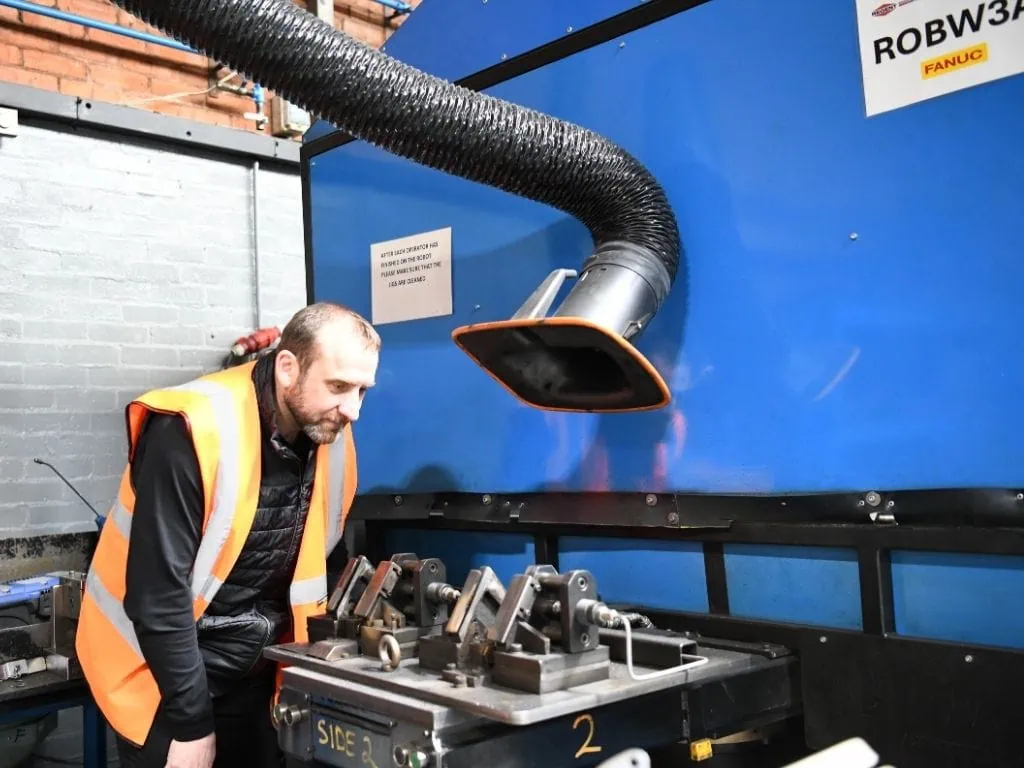
“We have a 700-tonne press and robotic weld capability that could support some serious components. The question is how we in the UK unlock that latent capacity quickly and intelligently to support Tier 1 suppliers.”
“Automation like ours adds in scalability and resilience that gives UK sovereign manufacturing a real differentiator against offshore alternatives. If we look at true landed price, quality and the net gain to our economy, the UK is a very low risk supply chain partner”
While large primes dominate defence headlines, it is the network of specialist manufacturers — it is tier 2 and tier 3 toolmakers, pressworkers, fabricators, and finishers — that provide the flexibility required to respond to shifting programme demands.
The EY report calls for a more “nimble approach to procurement” — something Stuart believes smaller, highly capable manufacturers are uniquely positioned to deliver.
“Tier 2 and Tier 3 businesses bring something critical to defence: agility,” he explains.
“We’re set up to solve problems quickly — whether that’s redesigning a pressing for manufacturability, adapting tooling at pace, or stepping in when there’s a bottleneck in the supply chain.”
“In aerospace and defence, timelines can change overnight. The ability to respond without layers of bureaucracy is where companies like Regent add real value.”
As defence budgets grow, the challenge will not simply be funding programmes, but ensuring that UK-based supply chains can scale in parallel.
EY’s analysis highlights that only 4% of MOD spending currently reaches SMEs, despite their critical role in delivery. Increasing that participation will be key to maximising economic impact and strengthening resilience.
For Regent Engineering, the opportunity is clear: to act as a responsive, technically capable partner to Tier 1 suppliers, helping them meet demand without compromising on quality or lead times.
“Whether it’s high-tonnage presswork, welded assemblies, or fabricated components, we can step in as an extension of their capability.”
“The UK already has the skills, the machinery, and the experience. What’s needed now is better alignment between procurement strategies and the businesses that can deliver.”
The broader message from both industry and policymakers is clear: defence spending must translate into domestic industrial strength.
With nearly a third of MOD expenditure directed towards capital investment — infrastructure, equipment, and technology — the potential for long-term productivity gains is significant. But realising that potential will require closer collaboration across the supply chain, faster procurement cycles, and a willingness to engage a broader base of suppliers.
For Regent Engineering, the moment represents more than just a commercial opportunity — it is a chance to reinforce the role of British manufacturing at the heart of national security and economic growth.
“This is about the future of UK manufacturing,” Whitehouse concludes.
“If we get this right, we’re strengthening our security and we’re building a more resilient, more capable industrial base for generations to come.”